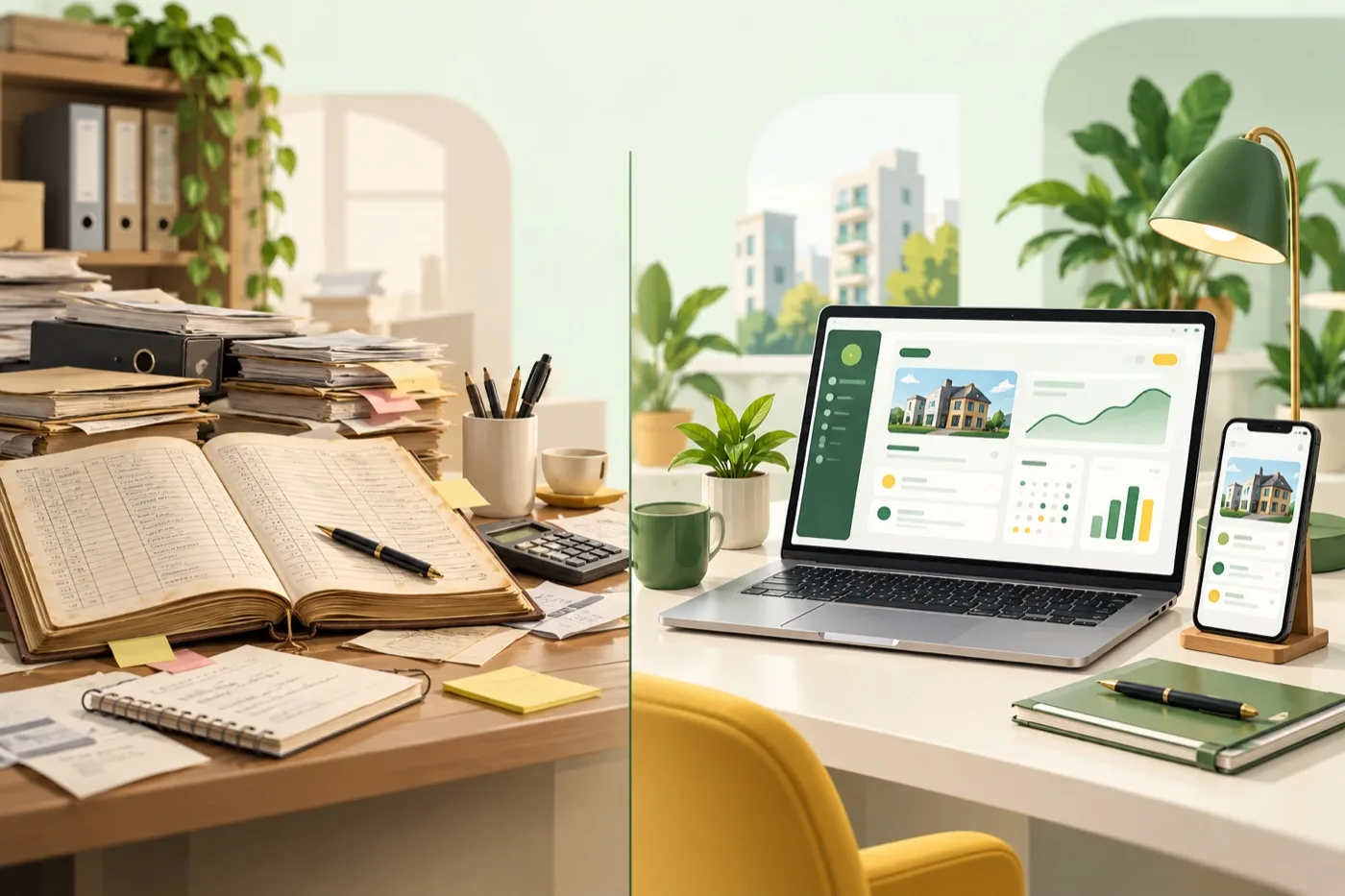
Walk into the office of almost any landlord or small property manager in India and you will find the same toolkit: a thick rent register, a diary of tenant numbers, a few Excel files with slightly different versions of the truth, and a phone full of WhatsApp chats, UPI apps and bank alerts.
These methods earned their place. They are familiar, cheap and need no training. But as soon as you manage more than a couple of units — or share the work with a family member, caretaker or manager — they start to crack.
This guide compares the legacy approach with smart rental management, task by task, so you can decide what is worth changing.
KEY TAKEAWAYS
- Legacy tools record; smart tools act. A register notes that rent is due; a smart system reminds the tenant, collects the money and issues the receipt.
- The biggest cost is fragmentation. Information spread across a notebook, sheets and several apps is what causes missed payments and disputes.
- You don't have to change everything at once. Start with the ledger and reminders, then move documents and expenses.
The legacy toolkit, honestly assessed
The rent register and notebook
What works: It is always available, needs no electricity or login, and many landlords trust ink more than screens.
What breaks: It cannot remind anyone, it cannot be searched, and it exists in exactly one place. If it is lost, damaged or simply at home when you are at the property, the record is gone. Handwritten entries also become the weak point in any dispute.
Spreadsheets (Excel or Google Sheets)
What works: Flexible, free and familiar. Great for a quick summary.
What breaks: Sheets depend entirely on someone updating them. Formulas break, versions multiply ("rent_final_v3_NEW.xlsx"), and there is no link between the sheet and the actual money arriving in your bank. Sheets also don't send reminders or receipts.
WhatsApp for everything
What works: Every tenant is already on it and replies quickly.
What breaks: Important information — payment screenshots, maintenance photos, agreement PDFs — gets buried in chat history. There is no structure, no status and no way to see "who hasn't paid this month" at a glance.
A different app for every job
What works: Each app does its one thing well — a UPI app to receive money, a notes app for repairs, a scanner for documents, an accounting tool for the CA.
What breaks: None of them talk to each other. You become the integration layer, copying numbers from one app into another every month.
Side by side: legacy vs smart
| Task | Legacy method | Smart rental management |
|---|---|---|
| Knowing who has paid | Check register, bank app and WhatsApp | One dashboard shows paid, pending and overdue |
| Rent reminders | Type messages by hand, every month | Scheduled WhatsApp, SMS and email reminders |
| Collecting rent | Share UPI ID, then match bank credits manually | Personal pay links, auto-matched to tenant and month |
| Receipts | Write or type them when asked | Sent automatically the moment payment clears |
| Agreements & IDs | Drawer, email and phone gallery | Stored with the tenant, with expiry reminders |
| Maintenance requests | Calls and chat messages | Tracked tickets with status and history |
| Expenses | Separate notebook or sheet | Logged per property, feeding a live P&L |
| Handing over to family or staff | Explain the system, share the notebook | Invite them with role-based access |
| Tax time | Hunt for bills and bank statements | Export ledgers and expense reports in one click |
Where legacy methods cost you money
It is tempting to think of legacy methods as "free". The costs are real, just hidden:
- Late and missed rent. Without consistent reminders, some rent simply arrives later — and occasionally not at all until you notice.
- Missed escalations. An agreement says rent goes up 5% after 11 months. If nobody remembers, the old rent quietly continues.
- Unrecovered charges. Electricity, maintenance and repair charges that should be passed on get forgotten.
- Deposit disputes. At move-out, unclear records about what was paid and deducted lead to arguments.
- Your own time. Hours every month on work that software can do in seconds.
Where smart systems genuinely help — and where they don't
Smart rental management is not magic. It won't find you a good tenant or fix a leaking pipe. What it does is remove the repetitive, error-prone admin so you can spend your time on decisions that actually need you.
It works best when:
- You manage more than two or three units, or plan to grow
- More than one person is involved — a spouse, parent, caretaker or manager
- You want clean records for disputes, audits, loans or selling a property
- You are tired of being the reminder service for your tenants
If you manage a single flat and enjoy your notebook, that's fine. The moment you catch yourself scrolling WhatsApp to confirm whether someone paid, it is time to switch.
How to move from legacy to smart without chaos
You don't need a weekend-long migration. A calm transition looks like this:
- Week 1 — Set up properties and tenants. Copy the basics from your register or sheet: units, tenants, rent and due dates.
- Week 2 — Turn on reminders and pay links. Let the next rent cycle run through the new system.
- Week 3 — Upload key documents. Agreements first, then ID proofs and police verification.
- Week 4 — Start logging expenses. Snap bills as they come in; don't worry about the past year yet.
After one full rent cycle, most landlords stop opening the register altogether.
Stuck with registers and spreadsheets?
Our team will show you how your current records map into RentDedo — rent, tenants, documents and all — in a free, personalised demo.
The bottom line
Legacy methods aren't wrong — they are simply manual. Every one of them depends on you remembering, typing, checking and chasing. Smart rental management flips that: the system does the remembering and chasing, and you step in only when something genuinely needs a decision.
RentDedo brings rent tracking, reminders, tenant records, documents, maintenance and expenses into one app designed for how rentals work in India. Book a free demo to see it with your own properties.